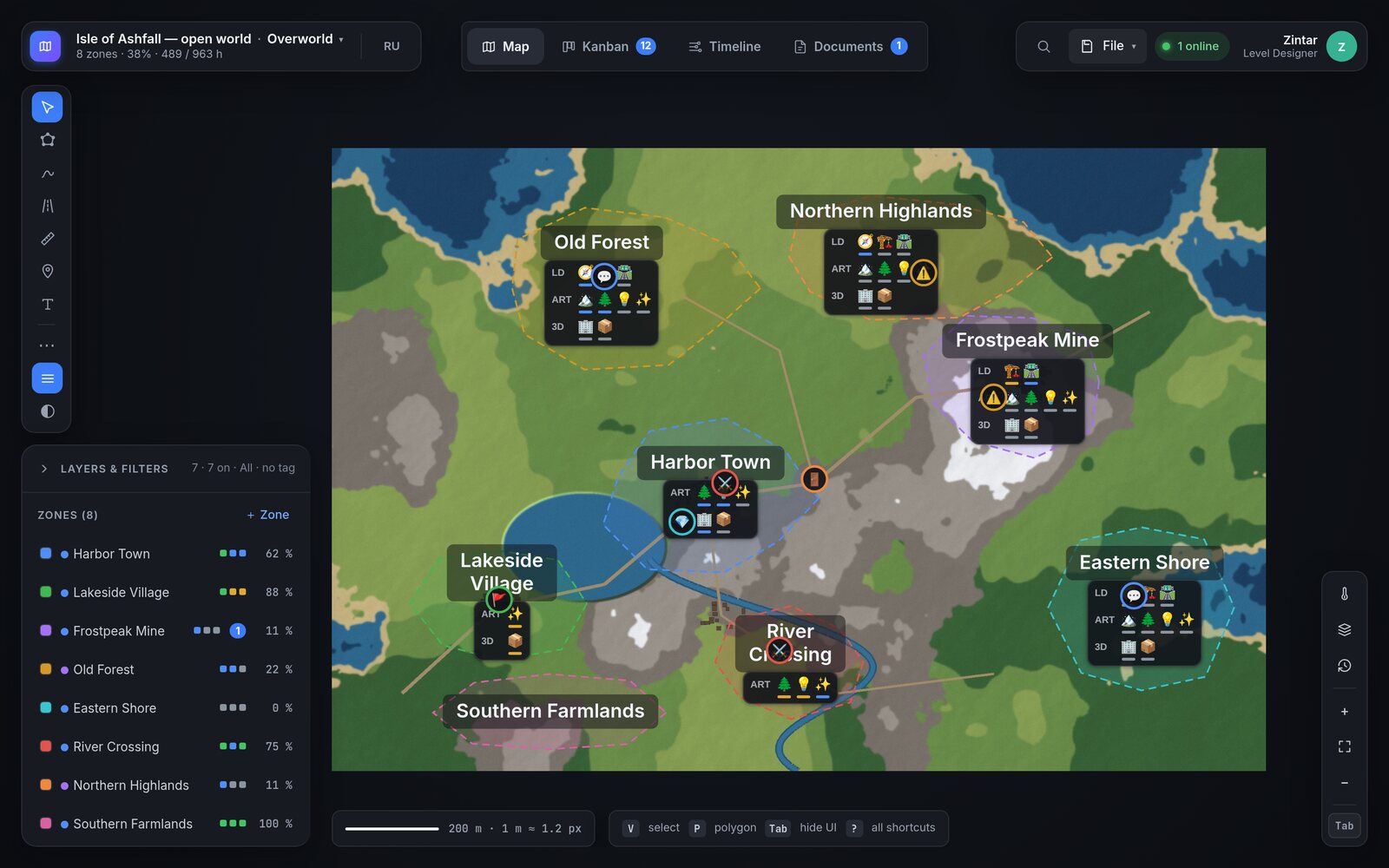
Open-world production lives in five tools at once: arrows in Miro, tickets in Jira, notes in Confluence, statuses in a spreadsheet, and the actual map somewhere else. Vellumap puts all of it on the map itself — every zone carries its own status, tasks, discussion and references.
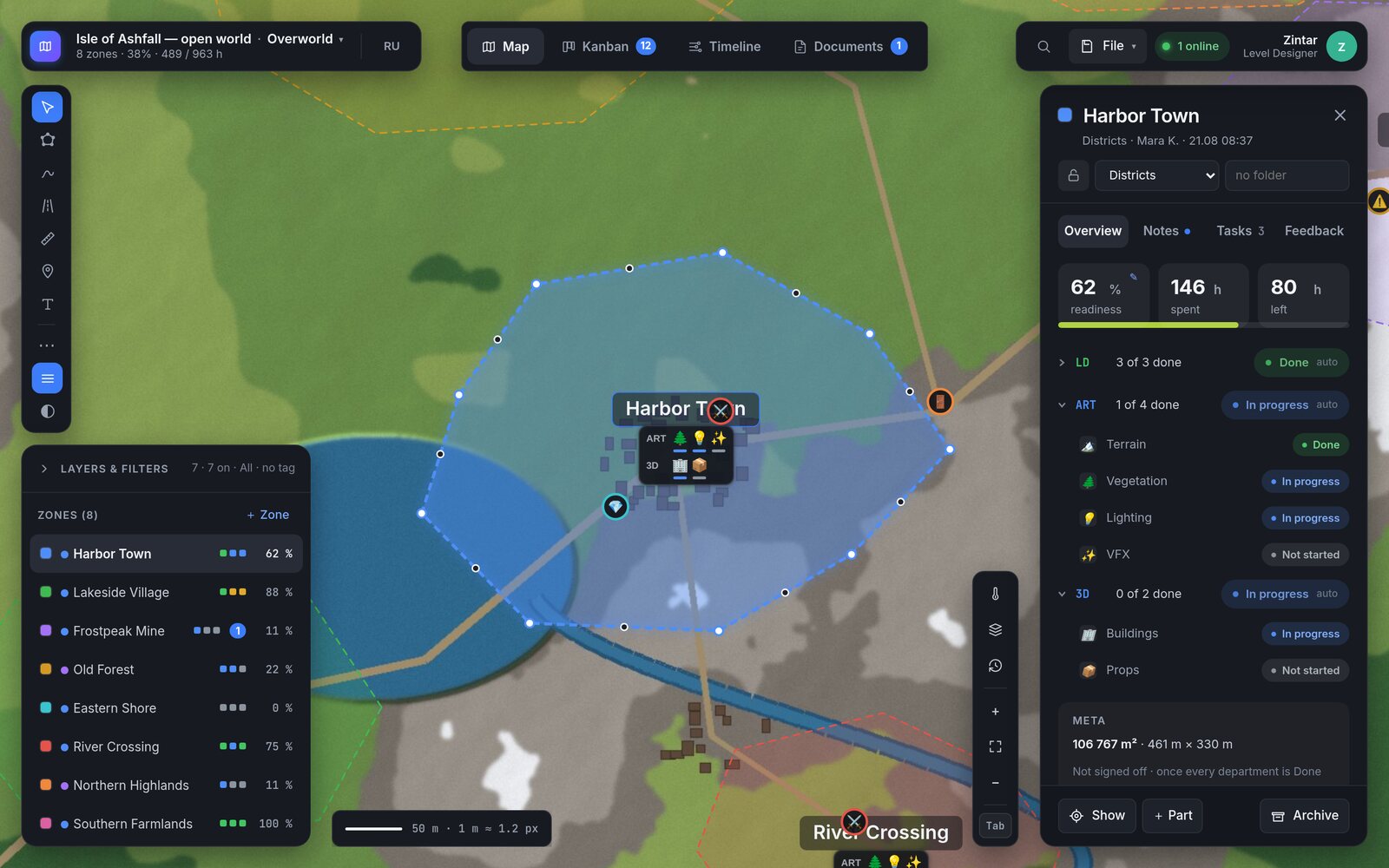
Click a zone and you get its whole story — instead of reconstructing it from four services and a chat thread.
You define them yourself: level design, game design, narrative, art, 3D, VFX, QA, production — whatever your pipeline actually has. Each gets its own stages and sub-sections, and a department with sub-sections is calculated from them, so nobody reports readiness twice.
Zone progress rolls up into map progress, weighted by area and hours. The lead gets a heat map instead of a status meeting.
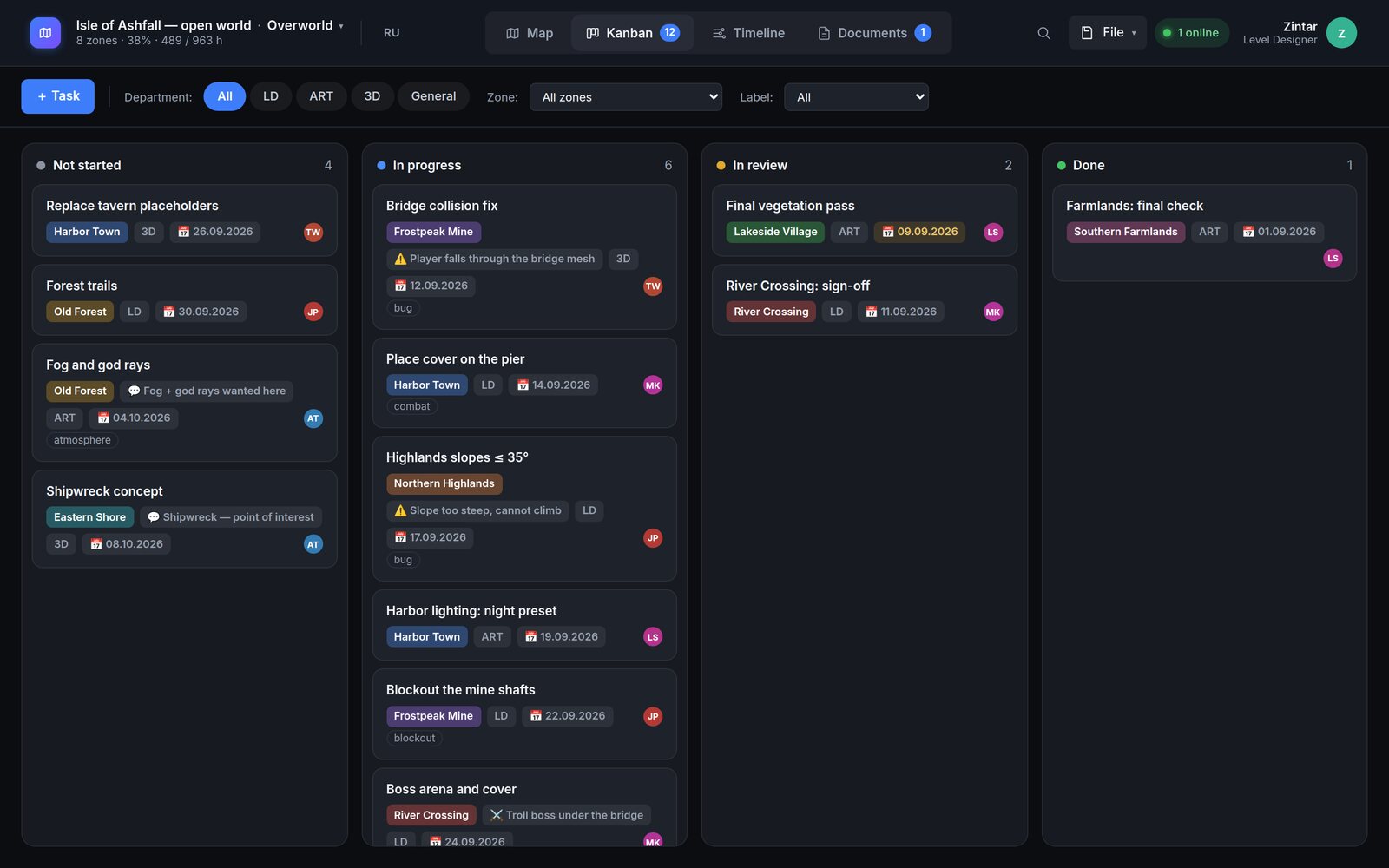
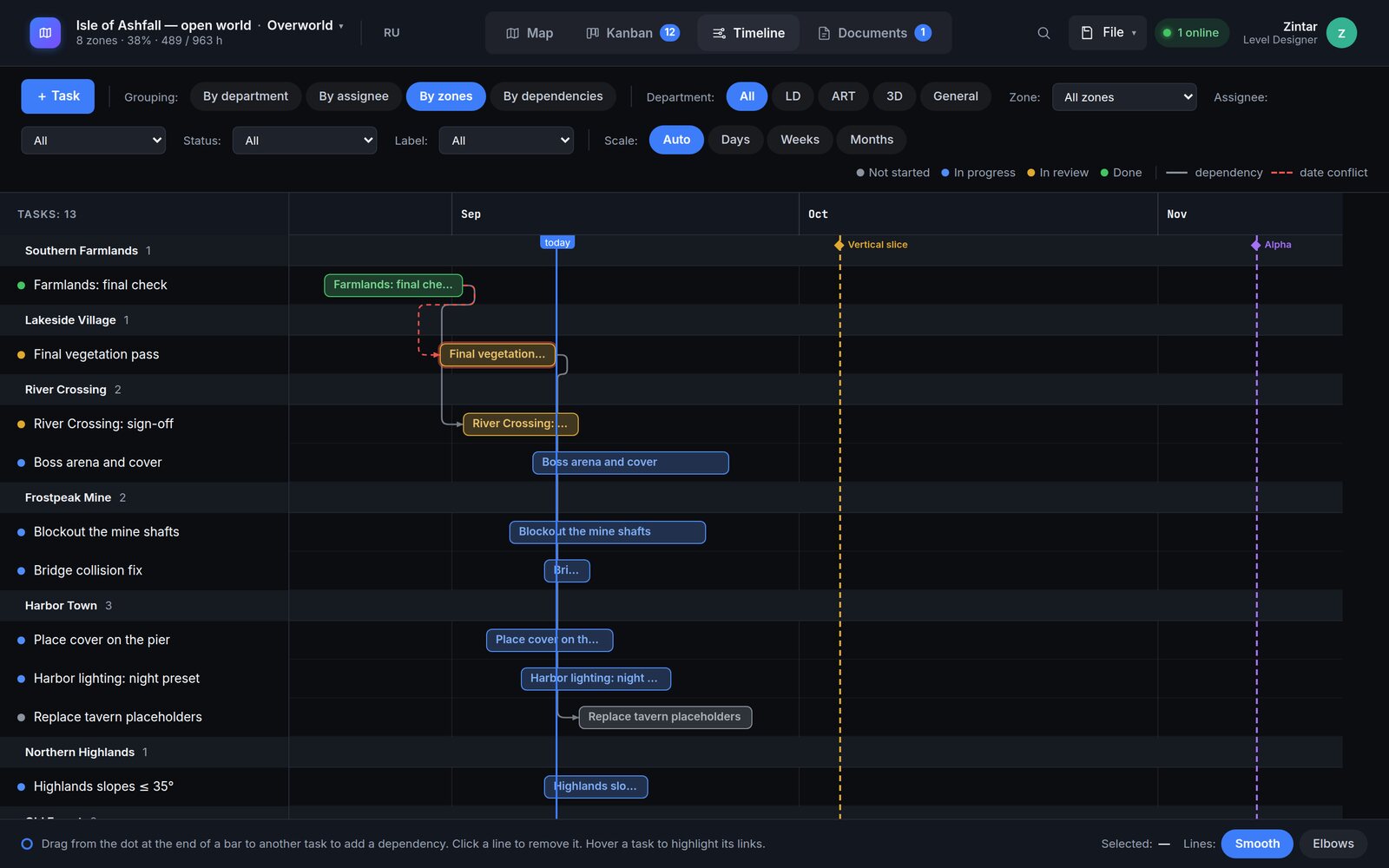
Kanban and a timeline where you drag a link from one task to another. A task that starts before its blocker ends is flagged in red.
Comments, checklists and reference images belong to the zone, not to a chat. The note about the harbour is on the harbour.
Two-way Jira sync, export of the markup to Unity and Unreal, read-only links for publishers and guests.
A full archive of every board, image and revision downloads in one click. Self-hosted option available — one Node.js process on your own machine.
In euros, VAT not included. Only editors are counted — viewing is free and unlimited on every plan.
On your own servers: annual studio licence from €6,000 for up to 30 editors, updates included; installation and integrations billed hourly. Data is hosted in a Germany (EU) data centre, backed up daily, kept for 30 days. Under a separate agreement the instance runs wherever you need it — including entirely inside your own network. Not sold to legal entities registered in the Russian Federation or the Republic of Belarus. Prices as of September 2026.
Dmitriy Gaiduk — level designer, 8 years in the industry. Worked on
Warhammer 40,000: Rogue Trader, Pathfinder: Wrath of the Righteous and a number of other
projects, open-world among them. I built this because I got tired of hunting for the state
of a location across five services, and my colleagues got hooked on it within a couple of days.
I work asynchronously, in writing — no calls, no meetings. LinkedIn, email, your tracker,
whatever you already use. That is not a scheduling problem to work around: written questions get
written answers, usually the same day, and both sides keep a record of what was agreed.
Setup, onboarding and support work the same way, and the demo shows more in five minutes than a call would in thirty.
Message me on LinkedIn
The demo gives you a private sandbox copy of a fictional open-world project. Break anything you like — nobody else sees it.
Open the demo